
Sewing instructions Overall Canan
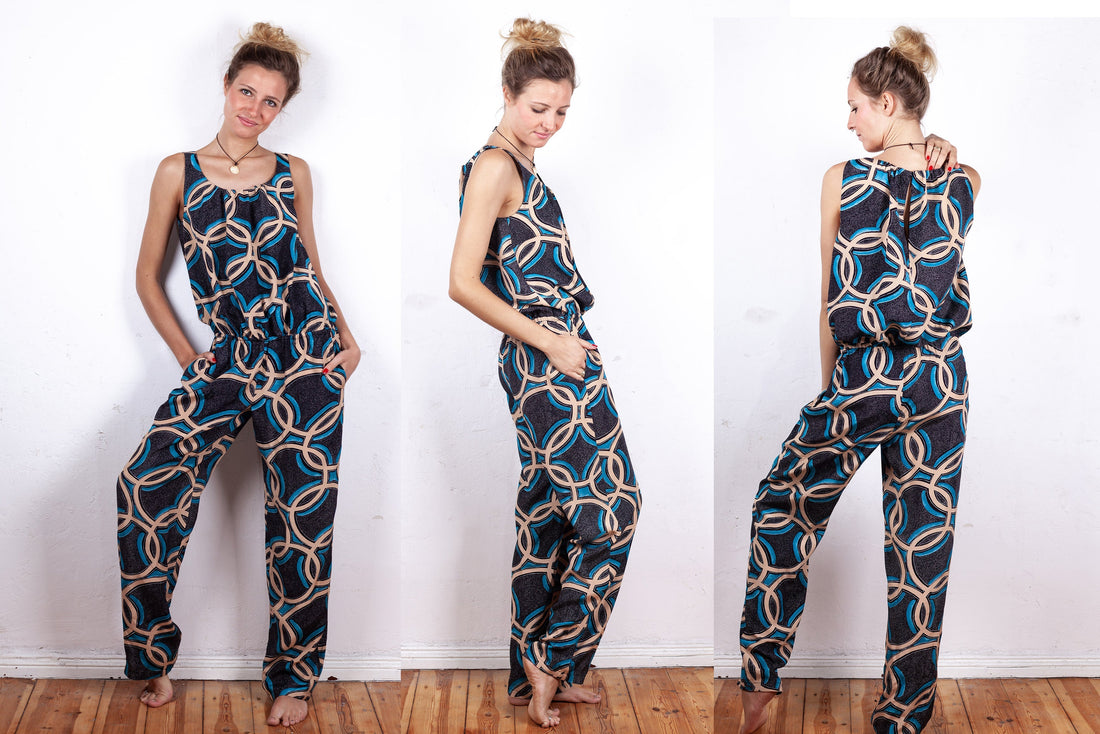
Overalls are a casual alternative to dresses or the classic shirt-and-trousers combination. Our Canan overall pattern is sleeveless and features a relaxed, loose fit. The elasticated waist ensures a perfect fit and gives the overall a feminine silhouette. Combined with high heels and a high-quality fabric, this jumpsuit is also perfect for evening wear.
Side seam length from seam = 104 cm (sits slightly lower than waist)
Canan was sewn from a lightweight viscose fabric in this tutorial.
Materials needed:
We recommend a soft, flowing fabric, such as viscose, silk, jersey or a wool georgette.
Sizes 34-38
- Outer fabric 2.40 m (140 cm wide)
- Elastic band 0.80 m (1 cm wide)
Sizes 40-44
- Outer fabric 3.00 m (140 cm wide)
- Elastic band 0.90 m (1 cm wide)
Sizes 46-50
- Outer fabric 3.40 m (140 cm wide)
- Elastic band 1.10 m (1 cm wide)
Sizes 34-50
- Button 1 piece (7 mm diameter)
- Insert 0.70 m (90 cm wide)
- Fixing tape 0.90 m (12 mm wide)
Just so you know in advance:
Cut:
Seam allowances are included - 1cm wide or as indicated by the marking notches!
Cut out the pattern pieces from your fabric. Align the selvedges parallel to the center so you can lay the pattern pieces on the fold. All pattern pieces should be placed with the printed side facing up. Always align the grainline arrow in the same direction on all pieces and parallel to the selvedge of the fabric. Transfer all notches from the pattern by making a 3mm snip with scissors or using chalk, and mark the ends of the bust darts. Snip the seam allowance on the fold, as this is always the center point. It's best to roughly cut out all the outer fabric pieces that will be fully interfacing first. After you've secured the interfacing, cut them out precisely. There's also a video here about gluing and securing pattern pieces.
If you want to make your canan out of corduroy, please note that corduroy should be cut against the grain. We have a video for you on this.
If you want to make your Canan out of plaid fabric:
Dagmar shows you the best way to cut plaid fabric in this video.


You will need the following fabric:
- 1x front part in breakage
- 2x back piece, mirror image
- 1x strip for eyelets
- 2x pocket bags, mirror images
- 2x front trousers, mirror images
- 2x back pants, mirror images
- 1x tunnel at the front of the break
- 1x tunnel at the rear of the break

Rough cutting
also with insert:
- 1x VT document in breakage
- 2x RT receipt, opposite

Fine cutting
also with shaping tape:
- 1x neckline front facing
- 2x neckline back panel facing
Sewing instructions:
Seam allowances are included - 1cm wide or as indicated by the marking notches!
To sew this jumpsuit, you'll need a sewing machine and an overlock machine, or alternatively, the zigzag stitch on your sewing machine to finish the raw edges. Use a jersey needle or a fine sewing needle (size 70) appropriate for your fabric. The colored lines in the pictures, in addition to the written instructions, show you where to sew seams. When sewing, pay attention to the seam allowance included in the pattern. Seam allowances not specifically marked are 1 cm wide!
Have fun sewing!

It's best to start with the bust dart.

Sew the back pieces together, right sides facing, up to the notch (for the slit). Finish the seam allowance below the notch individually and press the seam allowances open.
Here is a video on how to process the eyelet.

Turn the eyelet inside out and sew it to the seam allowance between the notches on the back piece. It should be the correct size to match the button.

Neaten the edges of the receipts marked in orange.

Gather the section from the notch to the center back to 8cm. To do this, sew with a long stitch 0.7cm and again slightly over 1cm from the cut edge. Then grab the loose ends of both seams and gather the fabric to the specified length. Repeat this process for all other gathers on the overall. There is also a video tutorial available.

Sew the back facing to the neckline and slit of the back piece. At the gathered area, sew between the two gathering seams. After sewing the facing to the back piece, unpick the lower seam you created for the gathering. Do this for all other gathers as well.

Now the slit and the back neck opening are turned inside out. The eyelet for the button now faces outwards.


Now gather the neckline of the front piece using the same principle.

Pull on the threads until the specified length is reached.

Turn the neckline of the front piece inside out as with the back piece, undo the lower gathering seam and topstitch the seam allowance flat to the facing up to just before the shoulder.

Finish the side seams of the front and back pieces and sew them together right sides facing along the side seam with a 1.5cm seam allowance. Press the seam allowances open. Sew the side seams of the facings together in the same way.

Now, turn the armholes right side out with the facing. Pay attention to the notches and align the side seams correctly.

Trim the seam allowance at the armhole and make small incisions at intervals. This will help the facing lie flatter after turning.

Stitch the seam allowance flat against the facing again and iron the armhole.

Now the shoulder straps need to be connected. To do this, insert the strap of the front piece into the opening of the back strap.

Reach between the facing and the front piece and pull out the strap. Close the shoulder seam with a 1cm seam allowance. The top is now finished, and we'll turn our attention to the trousers.

Finish the raw edges of the trouser pieces at the side seams, crotch seams, inseams, and around the pocket bags. Place the pocket bags right sides together with the right sides of the trouser pieces. Topstitch the pocket openings between the notches with a 1.5 cm seam allowance.

Place the front of the trousers on top of the back and the pocket bags on top of each other. Sew the side seam above and below the pocket opening together and close the pocket bag.

This is what the finished pocket opening looks like from the outside. Repeat this process for the second pocket opening. Iron the pocket bag towards the front of the trousers and secure it to the seam allowance of the front trousers. Press the side seams open.

Close the inseam with a 1.5cm seam allowance (marked in orange), turn the trouser legs right side out and then sew the front and back seat seams together right sides facing.

Now take the top again and gather the front and back pieces at the hem between the notches, as before. Adjust the width of the top to match the width of the trousers.

Sew the trousers and top together, right sides facing, with a 1cm seam allowance. Use the notches to mark the position of the side seams and the front and back center seams.

Sew the tunnel together at the side seams, right sides facing. It's best to mark the front tunnel with chalk on the left side to avoid confusion.

Fold the top over the pants to access the dividing seam. Sew the top edge of the casing to the seam allowance of the dividing seam. Before doing so, you could press the bottom edge of the casing under by 1 cm.

Fold the casing over the seam allowance onto the trousers (you may need to trim the seam allowance slightly). Topstitch the casing close to the edge of the trousers, leaving a small opening for inserting the elastic.
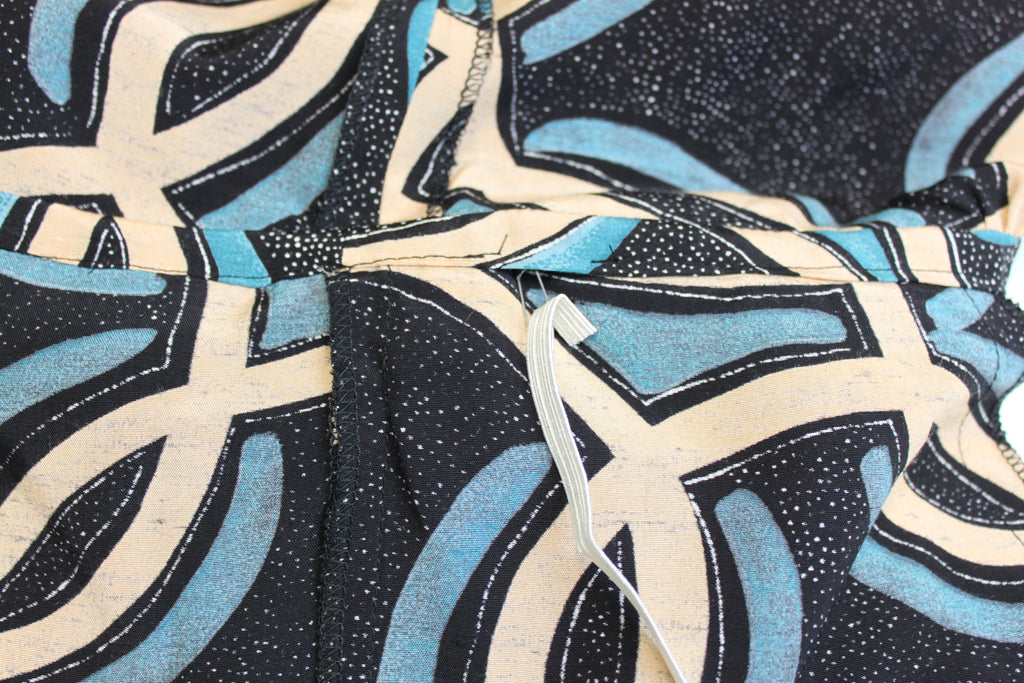
Thread the elastic through the casing using a safety pin. It's best to try on the overalls to determine the correct elastic length and leg length for hemming. After trying them on, sew the elastic ends together and close the opening in the casing.

Iron the hem over twice by 2cm and then stitch it down.

Finally, sew a button onto the top that matches your eyelet.
Your CANAN is finished!
If you get stuck or have any questions, please feel free to contact us by email at info@schnittmuster-berlin.de. We will reply as soon as possible.
Have lots of fun with your new designer piece!
Sincerely, your Schnittmuster-Berlin team.
